
Humanoid robots have long occupied a powerful place in human imagination. Shaped like us, moving among us, and increasingly able to understand and respond to our world, they represent one of the most ambitious directions in modern robotics. What was once confined to research laboratories and speculative fiction is now entering real environments, driven by rapid progress in artificial intelligence, sensors, materials, and mechanical design.
This evolution is not about creating machines that imitate humans for novelty alone. It is about building robots whose form and behavior allow them to operate naturally in spaces designed for people. As humanoid robots gain new capabilities, they are beginning to demonstrate how closely technology can align with human environments, social norms, and practical needs.
The Purpose Behind the Humanoid Form
The humanoid shape is not an aesthetic choice but a functional one. Human spaces, from homes and offices to hospitals and public buildings, are built around the proportions, movements, and reach of the human body. Doors, stairs, tools, furniture, and controls all assume a certain height, grip, and posture.
Humanoid robots are designed to navigate these spaces without requiring major structural changes. Arms that can reach shelves, hands that can grasp tools, and legs that can step over obstacles allow them to function where wheeled or fixed robots struggle. This adaptability makes humanoid robots especially valuable in environments that are complex, crowded, or constantly changing.
Beyond physical compatibility, the humanoid form supports social interaction. People instinctively understand body language, posture, and gesture. Robots that can use these cues appropriately can communicate intent more clearly, making collaboration safer and more intuitive.
Advances in Movement and Physical Intelligence
One of the most visible signs of progress in humanoid robotics is movement. Early humanoid robots were slow, rigid, and fragile. Modern systems demonstrate smoother motion, improved balance, and the ability to recover from disturbances.
This progress comes from advances in actuation, materials, and control algorithms. Lighter components, flexible joints, and more responsive motors allow robots to move with greater efficiency. At the same time, improved perception systems enable them to sense contact, adjust posture, and maintain stability in real time.
Physical intelligence is emerging as a key concept. Rather than relying solely on precise preprogrammed motions, humanoid robots are learning to adapt their movements based on feedback from the environment. This allows them to handle variation, whether lifting objects of different weights or navigating uneven terrain.
Expanding Cognitive Capabilities
Movement alone is not enough for meaningful deployment. Humanoid robots are becoming increasingly capable at understanding context, instructions, and goals. Advances in artificial intelligence are enabling them to process language, recognize objects, and plan actions across multiple steps.
Modern humanoid robots can interpret spoken requests, identify relevant objects, and decide how to perform tasks safely. They can combine perception and reasoning to handle situations that were previously too unpredictable for automation.
Learning plays a central role in this expansion. Robots are trained using large datasets and simulations, then refined through real world experience. This allows them to generalize skills rather than memorize specific actions. As a result, a humanoid robot can apply knowledge gained in one setting to new environments with minimal adjustment.
Interaction and Social Awareness
For humanoid robots to operate effectively among people, social awareness is essential. This includes understanding personal space, recognizing emotional cues, and responding appropriately to human behavior.
Progress in human robot interaction has led to systems that can interpret facial expressions, tone of voice, and body language. While these interpretations are not perfect, they allow robots to adjust their responses in ways that feel more natural and considerate.
Clear communication is equally important. Humanoid robots are being designed to explain their actions, signal intentions, and ask for clarification when needed. This transparency helps build trust and reduces uncertainty during collaboration.
Importantly, designers are moving away from exaggerated human likeness. Subtle, functional expressions and movements are often more comfortable for users than overly realistic appearances. The goal is familiarity without deception.
Applications in Work Environments
Humanoid robots are beginning to show promise in a variety of professional settings. Their ability to use tools and navigate human oriented spaces makes them suitable for tasks that are difficult to automate with traditional machines.
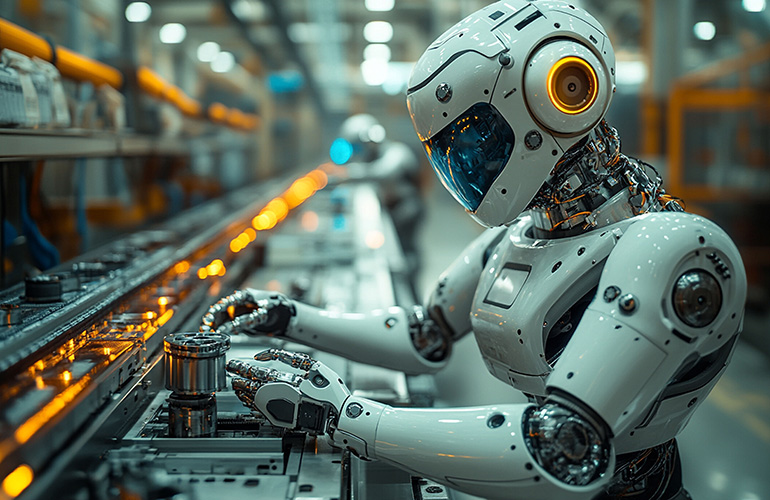
In industrial and logistics environments, humanoid robots can assist with handling materials, operating equipment, and supporting maintenance tasks. They can move between workstations, adapt to different tools, and collaborate with human workers.
In offices and commercial spaces, humanoid robots may support reception, facility management, and internal logistics. Their presence can improve efficiency while maintaining a consistent interface for interaction.
Crucially, their role is evolving toward assistance rather than replacement. By taking on physically demanding or repetitive tasks, humanoid robots can help reduce strain and improve safety for human workers.
Healthcare and Caregiving Potential
Healthcare presents both opportunity and responsibility for humanoid robots. Their human compatible form allows them to assist in environments where sensitivity, precision, and trust are critical.
In hospitals and care facilities, humanoid robots can help with patient support, mobility assistance, and routine monitoring. They can also assist staff by handling tasks that consume time but do not require medical judgment.
In home care settings, humanoid robots may support daily activities for older adults or individuals with limited mobility. Their ability to interact socially can help reduce feelings of isolation while providing practical assistance.
Ethical considerations are especially important in this domain. Humanoid robots must support human caregivers rather than replace emotional connection. Their deployment should always be guided by consent, transparency, and respect for dignity.
Learning, Training, and Education
Humanoid robots are also finding roles in learning environments. Their physical presence and interactive capabilities make them effective tools for demonstration, practice, and engagement.
In educational settings, they can support instruction by demonstrating concepts, assisting with hands on activities, and providing individualized feedback. For learners who benefit from repetition and patience, robots can offer consistent support without judgment.
In professional training, humanoid robots can simulate realistic scenarios for skill development. This is particularly valuable in fields that require physical coordination, safety awareness, or human interaction.
The key to success in education is alignment with human educators. Robots should enhance teaching, not distract from it, by supporting creativity, exploration, and confidence.
Ethical Design and Responsibility
As humanoid robots gain more autonomy and presence, ethical design becomes a central concern. The closer robots resemble humans in form and behavior, the more carefully their role must be defined.
Transparency is essential. People should understand what a humanoid robot can do, how it makes decisions, and when it is being controlled or supervised. Clear boundaries help prevent unrealistic expectations.
Privacy and data protection are also critical. Robots operating in personal or sensitive environments must handle information responsibly, minimizing data collection and prioritizing security.
Responsibility for robot actions must remain with human organizations. Clear accountability ensures that mistakes are addressed constructively and that trust is maintained.
Cultural Acceptance and Public Perception
Public attitudes toward humanoid robots vary widely. Cultural background, media representation, and personal experience all influence how people respond to humanlike machines.
Successful integration requires sensitivity to these differences. Designers and deployers must consider local values, social norms, and expectations. Engaging communities in dialogue helps address concerns and shape responsible use.
Over time, familiarity tends to reduce fear. As people interact with humanoid robots in practical, supportive roles, perceptions shift from novelty to utility. This gradual normalization is likely to define their future.
The Road Ahead
The expanding capabilities of humanoid robots point toward a future where machines and humans work side by side more closely than ever before. Progress will not be linear or uniform, but it will be guided by real needs rather than abstract ambition.
The most successful humanoid robots will be those designed with humility. They will focus on helping, adapting, and learning, rather than imitating humanity for its own sake. Their value will be measured by how well they integrate into existing systems and relationships.
Collaboration across disciplines will shape this path. Engineers, designers, ethicists, policymakers, and end users all have a role to play in defining how humanoid robots are developed and deployed.